MEDDIC Sales Methodology
A strategy built for a different era
Introduction
Enterprise sales has never been more complex or more consequential. For sales and marketing professionals who have watched carefully qualified deals stall, go dark, or evaporate without explanation, the frustration is familiar. Pipeline reviews reveal promising numbers but results tell a different story. This whitepaper series is written for sales and marketing professionals living inside that gap. The revenue leaders, account executives, demand generation managers, and go-to-market strategists who have followed the frameworks, run the plays, and still find themselves unable to fully explain, nevermind predict, what closes and what doesn’t.
The answer, this research argues, may lie not with the team or the process but with the framework itself.
Some of the sales
methodologies used
widely before the
creation of MEDDIC
were:
BANT –
SPIN Selling –
Miller Heiman –
Solution Selling –
Sandler Selling –
MEDDIC has served enterprise sales well. For three decades, it offered a disciplined lens for qualifying opportunities and aligning selling motions with buyer needs. What it could not anticipate was the degree to which modern buyers would restructure the evaluation process entirely. Researching in private channels, building consensus outside seller visibility, and arriving at first contact with a vendor already well into a decision. This whitepaper examines that transformation in depth, in six sections: Part One traces MEDDIC’s origins and the assumptions baked into its foundation; Part Two surfaces where those assumptions break down against contemporary buyer behavior; Part Three maps the hidden decision-making processes and the modern Decision-Making Unit that MEDDIC fails to capture; Part Four examines the Dark Funnel phenomenon and what it costs sellers who cannot see it; Part Five introduces the Buyer Activation Framework as a practical, research-grounded evolution of MEDDIC for the modern era; and Part Six confronts the organizational cost of non-adaptation. The goal throughout is not to dismiss what MEDDIC built, but to determine precisely where it needs to change. And chart a course toward more durable, predictable sales success.
Origins and Context
What is MEDDIC?
In 1996, a small team of sales executives at Parametric Technology Corporation (PTC), led by Dick Dunkel and Jack Napoli, faced a challenge that would ultimately reshape enterprise sales methodology for decades. PTC, a software company competing in the intensely competitive CAD/CAM market, was experiencing inconsistent win rates despite having a superior product in the market. When Dunkel and Napoli analyzed patterns across hundreds of deals, both wins and losses, they discovered something remarkable. Six common elements consistently determined whether an opportunity would close or collapse.
If a prospect wanted
to understand how
a CAD/CAM solution
might integrate with
their manufacturing
processes, they had
essentially one op-
tion: talk to the ven-
dor’s sales represen-
tative
From this observation, the MEDDIC sales methodology was born.
The results were extraordinary. Using this newly codified framework, PTC’s sales organization grew revenue from $300 million to $1 billion in just four years. A feat attributed largely to the discipline and rigor MEDDIC imposed on the qualification process [1] [2]. This wasn’t incremental improvement; it was a fundamental shift in how enterprise software was sold. The company sustained this momentum through 40 consecutive quarters of growth during the 1990s, a track record that made MEDDIC legendary in B2B sales circles [4].
Why Use Sales Methodology?
Beyond increasing sales, why do you need a qualification process methodology at all?
“Sales leadership teams are trying to create predictable revenue for their execs, board members, and shareholders. There are two critical factors required to create predictable revenue:
1. Efficient Resource Allocation
2. Forecast Accuracy” [7]
— Andy Whyte, MEDDICC
But MEDDIC‘s creation was not the work of a single visionary. As Jack Napoli himself later clarified, “MEDDIC, MEDDICC, or MEDDPICC is John McMahon’s sales brain codified… And then Dick and Jack told everybody at PTC about it” [3]
The methodology emerged from a collaborative effort by PTC’s global sales leadership team in the early 1990s. A dozen trailblazers who documented the “ephemeral, undefined best practices” of top performers and systematized them into a repeatable process [4]. Under the leadership of CEO Steve Walske, PTC prioritized, budgeted, and funded sales education at an unprecedented level, creating an environment where such innovation could take root and grow.
Success and Limitations
The belief is that
without pain, there is
no urgency. And with-
out urgency, deals
languish in perpetual
evaluation
The context in which MEDDIC emerged is critical to understanding its initial success. But more importantly today, it’s current limitations. The mid-90s represented the height of information asymmetry between vendors and customers in enterprise software sales. Buyers had limited access to product knowledge, competitive intelligence, and peer reviews. Vendor websites were primitive. Analyst reports were expensive and sparse. And there was no G2 Crowd, no Gartner Peer Insights, no TrustRadius. If a prospect wanted to understand how a CAD/CAM solution might integrate with their manufacturing processes, they had essentially one option: talk to the vendor’s sales representative.
In this environment, the salesperson controlled the narrative. They were educators, gatekeepers of knowledge, and orchestrators of the buying process. MEDDIC was designed to help these sellers navigate complex, committee-based B2B purchases where the challenge was not information access but information synthesis and stakeholder alignment. It provided a checklist, a series of required objectives, to ensure that critical questions were asked, answered, and documented before a deal progressed through the pipeline.
The Six Pillars Explained
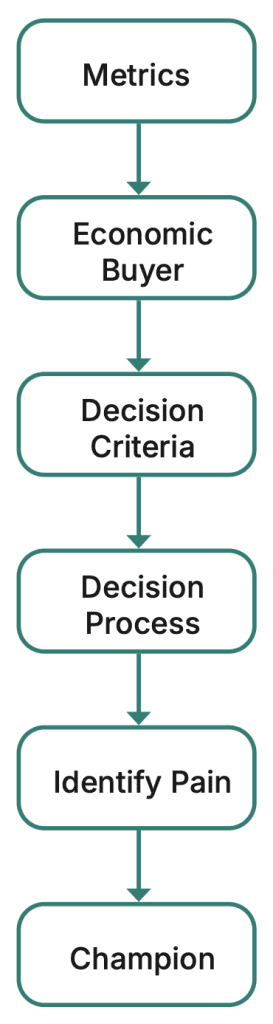
At its core, MEDDIC is an acronym representing six qualification criteria that, when properly validated, indicated a high probability of deal closure in the late 90s and 00s. The six criteria are:
- Metrics
- Economic Buyer
- Decision Criteria
- Decision Process
- Identify Pain
- Champion
Each element serves as both a diagnostic tool and a roadmap for seller action. Later on other criteria would be added as the methodology evolved, but these six are the core criteria of MEDDIC.
Metrics
MEDDIC insists on quantifiable, measurable business impact. Sellers must identify the economic benefit the prospect expects from the solution, typically expressed as cost savings, revenue growth, efficiency gains, or risk reduction. The premise: if a buyer cannot articulate a concrete ROI, the deal is built on quicksand. Metrics force both parties to move beyond feature comparisons to business outcomes, creating a shared language of value.
Example: A manufacturing firm estimates that reducing design iteration cycles by 30% will save $2.4 million annually in labor costs and accelerate time-to-market by six weeks, capturing an additional $5 million in revenue.
Economic Buyer
This is the individual with budget authority, and the person who can unilaterally approve the purchase. In the 1990s enterprise landscape, this was typically a VP or C-level executive who controlled departmental or corporate budgets. MEDDIC taught sellers to identify this person early, understand their priorities, and ensure direct access. The rationale: deals die when the “real” decision-maker is never engaged. Influence without authority is insufficient.
This is one of the key criteria that will significantly change later on as technology buying trends evolve.
Decision Criteria
What factors will the organization use to evaluate competing solutions? MEDDIC requires sellers to uncover both technical criteria (e.g., system integration, scalability, security) and business criteria (e.g., vendor financial stability, implementation timeline, total cost of ownership). By understanding how the prospect will score and rank alternatives, sellers can position their strengths against competitors’ weaknesses and proactively address disqualifying gaps.
Decision Process
In an era before main-
stream internet ac-
cess, peer review
platforms, and social
selling, buyers were
heavily dependent on
vendors for product
knowledge
How will the purchase decision be made? Who needs to be involved and what are the approval stages? MEDDIC assumes that complex B2B purchases follow a documented, governance-driven process that generally maps to the following activities:
- Needs assessment
- Vendor evaluation
- Proof-of-concept
- Contract negotiation
- Executive sign-off
The seller’s job is to map these process activities, anticipate bottlenecks, and align their sales cycle with the buyer’s timeline. This was particularly effective in the era of formal RFPs and waterfall procurement workflows [6].
Identify Pain
Pain is the emotional and operational driver of urgency. MEDDIC distinguishes between “latent pain” (problems the prospect doesn’t yet recognize) and “active pain” (acknowledged challenges creating real business consequences). The methodology emphasizes deep discovery in order to:
- ask diagnostic questions to unearth root causes.
- quantify impact.
- establish compelling events.
The belief is that without pain, there is no urgency. And without urgency, deals languish in perpetual evaluation.
Example: Classic MEDDIC discovery questions:
- “What happens if you don’t solve this problem in the next 90 days?”
- “Who is most affected by this issue?”
- “How much is this costing you today?”
Champion
The sales rep was si-
multaneously a diag-
nostician, educator,
and trusted advisor,
filling a genuine in-
formation void
The Champion is an internal advocate and someone within the customer’s organization who has power, credibility, and a vested interest in the seller’s success. They provide political intelligence, coach the seller on internal dynamics, and actively sell on the vendor’s behalf in rooms where the salesperson cannot be present. MEDDIC practitioners are taught to “test” Champions by asking them to perform small favors, such as:
- “Can you introduce me to the CFO?”
- “Will you share our proposal with the evaluation committee?”
A true Champion says yes and follows through.
Why MEDDIC Worked
MEDDIC’s dominance throughout the late 1990s and 2000s was no accident. It succeeded because it was precisely calibrated to the enterprise software buying environment of its time. In a world where several structural conditions aligned perfectly with the framework’s assumptions.
Linear Buying Processes
Enterprise software purchases in the 1990s and early 2000s followed predictable, waterfall-style procurement workflows. A typical decision process looked like this:
- Business case development (3–6 months)
- RFP issuance and vendor shortlisting (2–3 months)
- Product demonstrations and proof-of-concept (2–4 months)
- Finalist selection and contract negotiation (2–3 months)
- Executive approval and legal review (1–2 months)
This structure was well-suited to MEDDIC’s “Decision Process” pillar. Sellers could map the stages, identify who controlled each gate, and time their activities accordingly. The linearity meant that if you understood where you were in the process, you could predict what would happen next [6].
Information Scarcity Favored the Seller
In an era before mainstream internet access, peer review platforms, and social selling, buyers were heavily dependent on vendors for product knowledge. If a prospect wanted to understand the technical architecture of PTC’s Pro/ENGINEER software product, or how it compared to Dassault Systèmes’ CATIA product, realistically, all they could do is:
In the 1990s and early
2000s, this was stan-
dard practice. Enter-
prise software deals
took 9–18 months to
close, and buyers ex-
pected and welcomed
this level of vendor
involvement.
- Attend a vendor-sponsored demonstration
- Purchase expensive analyst reports (Gartner Magic Quadrants, Forrester Waves)
- Talk to existing customers (if the vendor provided references)
This information asymmetry gave sellers tremendous leverage. They controlled the flow of data, framed the narrative, and could position their solution as the obvious choice by highlighting certain features while downplaying others. MEDDIC’s “Identify Pain” pillar thrived in this environment because the seller, through skilled questioning, could reveal problems the buyer didn’t know they had. The sales rep was simultaneously a diagnostician, educator, and trusted advisor, filling a genuine information void.
Concentrated Decision Authority
While MEDDIC acknowledged the existence of buying committees, decision-making authority in the 1990s was more centralized than it is today. The “Economic Buyer”, who was typically a VP of Engineering, CIO, or CFO, had genuine unilateral power to approve six or seven-figure software purchases. Yes, they consulted with technical teams, operations, and finance, but the final call was theirs to make.
This meant that if a seller could identify the Economic Buyer, build rapport, and align their pitch with that individual’s priorities, they could often bypass or manage other stakeholders through influence rather than direct engagement. The Champion was key to this strategy because they provided the seller with intelligence. For example, “the CIO cares most about TCO, not features”. In addition, the economic buyer could run interference with skeptics.
Deep Discovery in Long Sales Cycles
But the world was
changing. Even as
MEDDIC reached
peak popularity in
the mid-2010s, the
structural conditions
that made it effective
were quietly eroding
MEDDIC assumes, and even requires, that sellers have time to conduct thorough discovery. The framework is question-intensive. And to properly validate Metrics, Decision Criteria, Pain, and the Decision Process, a rep might need:
- Multiple stakeholder interviews (IT, operations, finance, end-users)
- On-site facility visits to observe workflows
- Joint value assessment workshops
- Proof-of-concept pilots lasting weeks or months
In the 1990s and early 2000s, this was standard practice. Enterprise software deals took 9–18 months to close, and buyers expected and welcomed this level of vendor involvement. The extended timeline gave sellers room to build relationships, educate prospects, and methodically work through the MEDDIC checklist.
The Golden Age
(2000–2015)
By the early 2000s, MEDDIC had transcended its origins at PTC to become the de facto standard for enterprise SaaS sales qualification. Salesforce, Oracle, SAP, and countless other technology vendors adopted variations of the framework, often customizing it with additional elements. Creating MEDDPICC and MEDDPIC variations mentioned earlier, which added “Competition” and “Paper Process” to address evolving complexity [2] [5].
Chaos Tamed by Disciplined Process
Sales leaders loved MEDDIC because it brought discipline to an often-chaotic process. The framework gave managers a consistent language for deal inspection, pipeline reviews, and performance coaching. Reps could no longer hide behind vague assertions like “the deal is progressing” or “they’re very interested.” Instead, they had to provide evidence:
Digital channels were
proliferating. And a
new phenomenon,
later dubbed the
“Dark Funnel”, was
beginning to reshape
the B2B landscape in
ways that would ren-
der traditional quali-
fication frameworks
increasingly obso-
lete.
- What specific metrics have been validated with the Economic Buyer?
- Who is our Champion, and what have they done to prove it?
- What is the next step in their Decision Process, and when will it happen?
This rigor paid dividends. Organizations that implemented MEDDIC reported improved deal visibility, better pipeline management, and more structured qualification processes [6]. The methodology also democratized sales excellence. Previously, top performers relied on intuition, relationship-building, and hard-to-replicate charisma. MEDDIC codified their behaviors into a teachable system, raising the floor for average performers.
It should be noted that MEDDIC’s golden age of success was concentrated primarily among large enterprise customers. With deals that typically had seven to nine-figure contract values, 12 to 18-month sales cycles, and formal procurement governance structures. Mid-market and commercial segments adopted lighter variants of the framework, often omitting the most discovery-intensive elements in favor of faster qualification. This distinction matters because the breakdown of MEDDIC’s core assumptions is not uniform across segments. It is most acute precisely where growth has been fastest over the last decade: mid-market and commercial SaaS. Precisely where buying committees have expanded most rapidly, and sales cycles have compressed most sharply.
Quiet Change on the Horizon
But the world was changing. Even as MEDDIC reached peak popularity in the mid-2010s, the structural conditions that made it effective were quietly eroding. Information was democratizing. Buying committees were expanding. Digital channels were proliferating. And a new phenomenon, later dubbed the “Dark Funnel”, was beginning to reshape the B2B landscape in ways that would render traditional qualification frameworks increasingly obsolete.
In the next part in this series, we will examine how these seismic shifts exposed the fault lines in MEDDIC’s architecture, transforming a once-dominant methodology into a framework struggling to keep pace with modern buyer behavior.
References
[1] DealHub, “What is MEDDIC Sales Methodology?”, DealHub Blog, May 14, 2025. [Online]. Available: https://dealhub.io/glossary/meddic-sales-methodology/
[2] MEDDICC, “MEDDIC Sales Methodology and Process”, MEDDICC.com, 2025. [Online]. Available: https://meddicc.com/meddpicc-sales-methodology-and-process
[3] Sales MEDDIC Group, “Sales MEDDIC Origin”, Sales MEDDIC Blog, October 5, 2020. [Online]. Available: https://www.salesmeddic.com/blog/origin-of-meddic
[4] MEDDIC Academy, “MEDDIC Sales Checklist — Framework by MEDDIC Academy”, MEDDIC Academy, April 23, 2025. [Online]. Available: https://meddic.academy/meddic-sales-methodology-checklist/
[5] Pipedrive, “MEDDIC Methodology, Sales Process & Training”, Pipedrive Blog, September 22, 2025. [Online]. Available: https://www.pipedrive.com/en/blog/meddic-sales-process
[6] Atlassian, “MEDDIC sales methodology explained”, Atlassian Work Life, July 22, 2025. [Online]. Available: https://www.atlassian.com/blog/project-management/meddic-sales-methodology
[7] A. Whyte, MEDDICC: The Ultimate Guide to Staying One Step Ahead in the Complex Sale, foreword by D. Dunkel and J. Napoli. Self-published, 2020.

Leave a Reply
Only people in my network can comment.